



Tawaki Project at IPC12
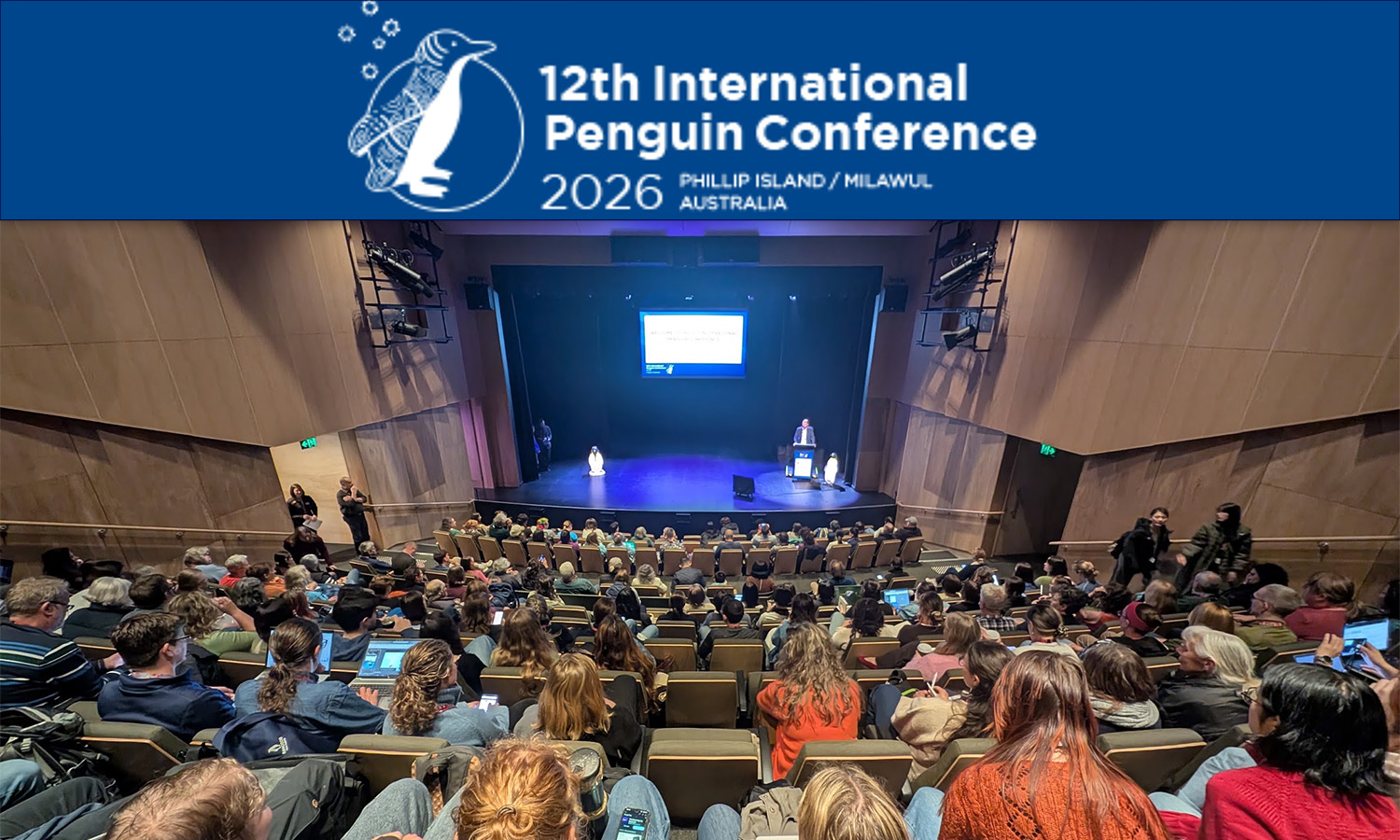
Last week, the Tawaki Project packed its bags for Phillip Island / Milawul in Australia, host of the 12th International Penguin Conference (IPC12). Held at the newly opened Berninneit cultural centre in Cowes from 31 August to 4 September, the conference drew more than 200 penguin researchers and conservationists from around the world… the biggest gathering of its kind since IPC11 in Chile in 2023. Over the course of the week, more than 150 presentations covered everything from genetics and disease to climate change and population monitoring, across all 18 penguin species. Four of those presentations came from our own team.
Dave Houston: Schrödinger’s Penguin
Dave Houston opened proceedings for the team with a talk asking a deceptively simple question: is the Erect-crested penguin endangered or not? Drone surveys and ground counts carried out between 2022 and 2024 across the species’ entire breeding range turned up around 27,800 pairs on the Bounty Islands and 29,800 on the Antipodes Islands. The catch is that the Bounty population has held steady for at least 25 years, while the Antipodes population, once the species’ stronghold, has dropped by more than 40% since the mid-1990s, largely due to skua predation. Dave’s talk showed how combining the two into a single global trend risks masking a serious crisis unfolding on the Antipodes.

Bianca Keys: two islands, two journeys
Otago University PhD student Bianca Keys followed with new tracking data from the same two populations, this time looking at where the penguins go before they moult. Between January and March 2024, her team fitted satellite tags to 10 adult breeding penguins on each island group and found strikingly different strategies: Bounty birds stuck to a narrow, productive band along the Subtropical Frontal Zone east of the islands, while Antipodes birds ranged far more widely into less productive subantarctic waters. The findings echo Dave’s message… the Bounty Islands may be the species’ best hope, but their narrow foraging range leaves them exposed to increasing commercial fishing pressure in that same productive zone.

Jeff White: 150 years of tawaki diets
Jeff White brought a historical angle to the podium, presenting results from an analysis of stable isotopes in tawaki (Fiordland penguin) feathers, some collected recently and others pulled from museum specimens dating back to the 1870s. Tawaki undertake one of the longest pre-moult foraging trips of any crested penguin, and Jeff’s analysis of 287 feather samples found that their diet and foraging areas have stayed remarkably stable for a century and a half. That’s a striking contrast to Eastern rockhoppers, which have shifted to lower quality prey over the same period and suffered steep population declines. The takeaway: dietary flexibility and a reliable food supply may be key to why tawaki have fared better than some of their crested relatives.

Thomas Mattern: 25 years of penguin research in Aotearoa
Closing out the team’s contributions was a keynote from Thomas Mattern, looking back on a quarter century of penguin research across New Zealand. From the first student projects in the late 1980s to today’s drone surveys and bio-logging devices, Thomas traced how far the field has come, and how much further it still has to go. Even the Yellow-eyed penguin, now one of the best-studied penguin species on Earth, continues its slow slide towards extinction, while species like the Erect-crested and Eastern Rockhopper penguins remain some of the least understood. His talk asked a hard question of the whole field: after 25 years, do we finally know enough to act, at the very moment acting has become harder than ever?

It was a strong showing for a small team, four talks covering three different penguin species and 25 years’ worth of fieldwork. Thanks to everyone who came along to ask questions, swap notes, and remind us why this work matters.